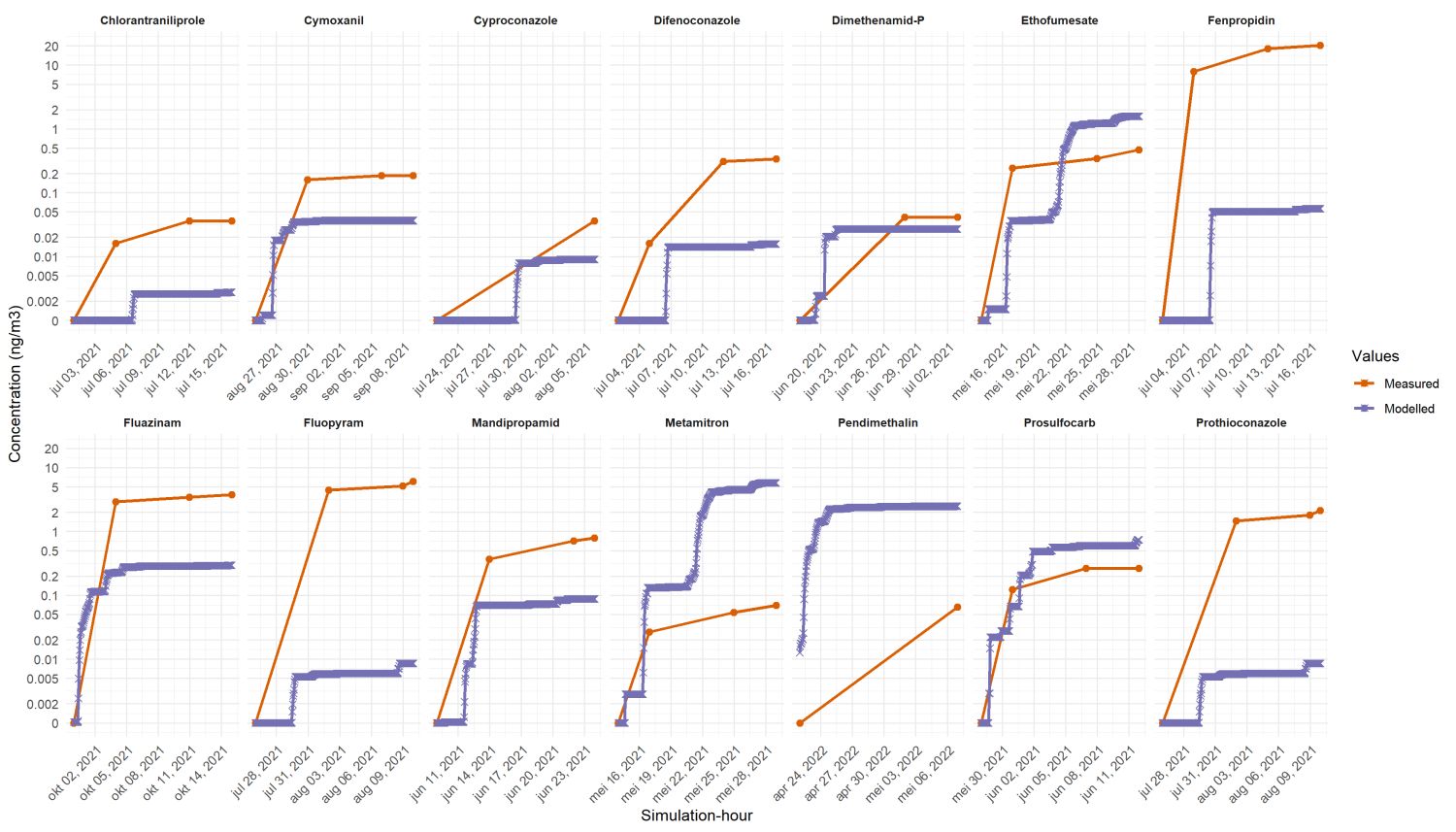
The SWIPPE model (SprInt WInd erosion model for PartIcle-phase PEsticides), developed within Work-Package 3 of SPRINT, estimates emissions of pesticide-laden dust from agricultural fields and their dispersion in the atmosphere. Building on existing wind erosion models, we adapted equations from APEX, as it incorporates vegetation cover alongside standard parameters such as surface roughness, field length, and climatic drivers. The model focuses on suspension processes, as these are the main contributors of fine particles (e.g. PM10) that can travel further distances. To link pesticide behavior in soil to atmospheric transport, SWIPPE integrates a sorption module (based on KOC values, as used in the PEARL model) and a Gaussian plume dispersion component with settling velocity by particle size. This framework allows us to simulate pesticide concentrations at downwind receptors with hourly resolution. Pesticide chemical conversion and wet deposition were not incorporated in this model.
To verify the model, we compared simulations against field measurements collected with an active air sampler in Valthermond, the Netherlands (Debler et al. 2024). Sixteen pesticides were selected for comparison, based on reported applications and sufficient detection frequencies. Model outputs were evaluated against measured concentrations by analyzing temporal patterns, cumulative values, and statistical bias, rather than standard regression metrics, given the limited number of paired data points. Despite uncertainties in input data such as soil moisture content and contributions from surrounding fields, SWIPPE captured temporal trends well, and in most cases, predicted concentrations were within the same order of magnitude as observations. This supports its use as a first step toward understanding particle-phase pesticide transport via wind erosion.
References:
- Debler, F., Abrantes, N., Harkes, P., Campos, I., Gandrass, J., 2024. Occurrence and distribution of pesticides and transformation products in ambient air in two European agricultural areas. Science of the Total Environment 940, 173705. https://doi.org/10.1016/j.scitotenv.2024.173705
Contact for model use/collaboration: d.m.figueiredo@uu.nl
Description for General Public
Soil from fields can carry traces of pesticides into the air, raising questions about how far these substances can travel and how much ends up in the environment. To better understand this, we developed a new computer model, SWIPPE, that simulates how soil particles are lifted by the wind, how pesticides attach to them, and how they spread through the air. Tests of the model showed that it generally reflects what was measured in the field, even if some details are still uncertain. This research helps us take steps toward understanding potential exposure from pesticide use, specially when attached to soil particles, and how to manage it better in the future.
Description for Policy Makers
The SWIPPE model (SprInt WInd erosion model for PartIcle-phase PEsticides) provides a framework for assessing pesticide concentrations in air resulting from wind erosion of agricultural soils. The model couples wind erosion dynamics, sorption behavior, and dispersion processes, offering concentration predictions at downwind locations. Verification against field measurements in the Netherlands showed good alignment of modelled and observed concentrations, typically within the same order of magnitude. While uncertainties remain—particularly regarding soil moisture and non-simulated nearby sources—the model is a promising tool for regulatory assessments, scenario testing, and informing policy on pesticide secondary drift (i.e. post-application).
Description for Scientists
SWIPPE is a modular wind erosion and dispersion model developed in R, combining APEX-based suspension equations, PPP-specific soil sorption (KOC-dependent), and a Gaussian plume framework with particle settling velocity (dry deposition). The focus on suspension processes targets PM10-sized fractions as the dominant transport vector. Model verification used 16 pesticides with adequate observational data from an active air sampler (Valthermond, NL). Evaluation relied on cumulative temporal trends and bias metrics due to sparse paired measurements. Results showed that for most compounds, predicted concentrations were within an order of magnitude of measured values, with largest biases on the order of ~15 ng/m³. Uncertainties are linked to soil moisture assumptions and unaccounted emissions from adjacent fields. Despite these, SWIPPE provides a useful tool for quantifying particle-phase PPP transport and can be extended to uncertainty analysis and scenario evaluation.
THE TOOL
Inputs:
BOX 1. Input used to run SWIPPE model. Input where assumptions had to be made are marked with an asterisk.
|
Source location and receptor location:
Meteorological parameter:
Soil properties:
Pesticide application:
Crop cover factor:
PPPs physico-chemical properties
|
Outputs: Predicted pesticides environmental air concentrations in particulate phase.