
Authors: Anke Huss (a.huss@uu.nl) and Arash Derakhshan (a.derakhshan@uu.nl)
Health Impact Assessment (HIA) is a structured, evidence-based process for predicting the potential health effects of a policy, program or project before it is implemented. It typically follows five steps:
- Screening to decide if an HIA is needed,
- Scoping to define which health outcomes and populations to study,
- Assessment of hazards and exposure pathways,
- Development of recommendations to manage risks, and
- Monitoring to track outcomes over time.
One of the objectives of the SPRINT project was to develop, test, validate and deliver a Global Health Risk Assessment Toolbox for the integrated assessment of the impacts of pesticides on terrestrial and aquatic ecosystems as well as on plant, animal and human health. Here, we will describe the HIA study on human health.
When applied to commonly used pesticides like glyphosate, HIA examines how people might get exposed to residues in food, water or the environment, quantifies internal doses through biomonitoring, and evaluates dose–response relationships for outcomes such as carcinogenicity or endocrine disruption.
It is important to recognize that causality cannot be derived when epidemiological and experimental evidence is insufficient. Without a robust body of consistent epidemiological findings and experimental studies that confirm biological plausibility, any observed associations remain tentative. This limitation means that while HIA can identify potential risks and highlight areas of concern, it cannot conclusively establish that glyphosate exposure causes specific adverse health outcomes. Instead, the assessment serves as a precautionary tool, guiding further research, regulatory decisions, and risk management strategies until stronger causal evidence becomes available.
In this report we first will provide a general description of the steps we have taken for the HIA and then will provide 2 detailed examples of HIA studies for glyphosate with results. Moreover we provide two Shiny apps: One for running different scenarios of HIA and calculation of attributable fraction and cases and one as a Monte Carlo simulation tool to estimate potential health effects from exposure to multiple pesticides.
From the left menu, users can access the abovementioned sections. In the following sections, the users will find a description of the tool and the information it provides for three different end-user groups. We highly recommend that users study this information before using the tool.
Description for General Public
Background
As part of the EU‑funded SPRINT project, we applied a method called Health Impact Assessment (HIA). This approach helps us understand how environmental factors—such as pollution or pesticide use—can affect people’s health.
How it works
HIA brings together different types of information to estimate potential health effects. It combines:
• How much of a pollutant (like pesticides) people are exposed to
• Scientific studies showing how that exposure is linked to health problems
• Data on how many people experience those health problems each year
By combining these elements, HIA can answer questions like: “If we change a policy, what will it mean for people’s health?” It is therefore a valuable tool for governments and decision‑makers. We showcase two examples for the Netherlands to outline how a HIA can be done.
Data sources
• Dutch data on pesticide use (here: glyphosate) near residential areas
• Estimated pesticide levels measured in urine samples from the Dutch population
• Scientific studies linking exposure a specific pesticide to health outcomes
Key steps
1. Exposure estimation – We calculated how many people were likely exposed to a specific pesticide (here: glyphosate) and at what levels.
2. Health link – We used scientific studies to identify possible health effects of exposure to the pesticide.
3. Impact calculation – We applied established equations to estimate how many cases of disease could be linked to exposure to this pesticide.
What it offers
Our analysis provided two examples of how HIA can be applied:
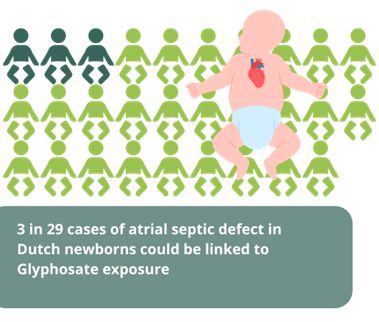
• Pregnant women and newborns: We examined the risk of babies being born with a heart condition called atrial septal defect (ASD). Findings suggested that in 2020, around 3 out of 29 ASD cases in Dutch newborns might have be linked to glyphosate exposure.
• Adults and metabolic syndrome: Using urine data, we estimated that each year about 221,143 cases of metabolic syndrome (around 5.2% of all annual cases) in the Netherlands could be associated with glyphosate exposure.
These examples show how HIA can quantify the potential health benefits of reducing exposure to harmful substances.
Limitations / Disclaimer
Our HIA tool is based on limited data and relies on assumptions that may not fully reflect real‑world risks. Current scientific studies do not yet provide consistent results across different populations, and the biological mechanisms are not fully understood. This means that the suggested associations should be seen as indicative, not definitive. To gain a clearer understanding of potential health effects, more rigorous population‑based and sex‑specific research is needed to examine the link between glyphosate exposure and adverse outcomes, including congenital heart defects such as ASD. Our work highlights the importance of studying pesticide exposure, but also the fact that human studies on pesticides and health outcomes remain scarce.
Description for Policy Makers
Background
Health Impact Assessment (HIA) is a structured process used to predict and evaluate the health effects of exposure to environmental pollutants—such as pesticides—in human populations. HIAs provide valuable information not only for scientists but also for policy‑makers and regulators, supporting evidence‑based decisions before implementing policies, programs, or projects.
How it works
HIA combines:
- Exposure data (how much of a pollutant people are exposed to)
- Scientific evidence linking exposure to health outcomes
- Population health statistics to estimate the scale of impact
This integration allows policy‑makers to understand the potential health consequences of environmental exposures and to anticipate the benefits of preventive measures.
Data sources
- Systematic review of scientific literature, including the study by Rappazzo et al. (2018)
- Dutch population data on pesticide exposure, specifically glyphosate use near residential areas
Key steps
- Identify exposure – Glyphosate exposure during pregnancy was assessed using Dutch residential data.
- Link to health outcomes – Literature evidence connected glyphosate exposure with congenital heart defects.
- Estimate impact – Using population data and established methods, the potential burden of disease was quantified.
What it offers
Our assessment provides evidence that exposure to a specific pesticide during pregnancy may contribute to preventable cases of congenital heart defects in Dutch newborns. In 2020, approximately 3 out of 29 cases of atrial septal defect (ASD) could be attributed to glyphosate exposure—representing over 10% of the total burden in the studied population.
While the absolute number may appear modest, the implications are significant: these are serious and preventable health impacts. Policies that reduce or eliminate exposure to a specific pesticide—particularly near residences and croplands—could directly prevent congenital health risks. These results provide quantitative support for pesticide regulation, exposure reduction strategies, and precautionary health policies.
Limitations / Disclaimer
Our HIA is based on limited data and assumptions that may not fully capture real‑world risks. Current evidence does not yet provide consistent results across diverse populations, and biological mechanisms remain insufficiently understood. Therefore, the associations presented should be interpreted as indicative rather than definitive.
To strengthen the evidence base, more rigorous population‑based and sex‑specific studies are needed to examine the link between exposure to a specific pesticide and adverse outcomes, including congenital heart defects. This highlights both the importance of precautionary action and the need for further investment in public health research on pesticide exposure.
Description for Scientists
Background
Health Impact Assessment (HIA) is an interdisciplinary approach used to evaluate potential health risks associated with exposure to environmental pollutants, such as pesticides. By integrating environmental epidemiology, toxicology, and exposure science, HIA assesses how pollutants may affect public health at the population level. In this context, HIA focuses on identifying links between environmental exposures and specific health outcomes.
How it works
HIA applies a structured framework that combines:
- Epidemiological evidence linking exposures to health outcomes
- Exposure data at the population level
- Quantitative methods to estimate attributable fractions and population burden
This allows researchers to translate exposure–response relationships into measurable public health impacts.
Data sources
- Systematic literature review identifying epidemiological evidence of glyphosate exposure and congenital outcomes (notably Rappazzo et al., 2018)
- National pesticide use data (2020) covering 2,256,482 grids in the Netherlands
- Population subset data: merged newborn subset (N=9,144) and total newborns (N=48,380)
Key steps
- Exposure–response function extraction – Odds ratios for exposure percentiles were taken from Rappazzo et al. (2018) and converted into kg‑based cutoffs.
- Exposure distribution analysis – National glyphosate application data were mapped to residential grids; ~96% of newborns lived within glyphosate‑applied grids.
- Attributable fraction calculation – Category‑specific attributable fractions (AFi) were derived (0.37%, 2.36%, 12.5%, 12.5%).
- Population attributable fraction (PAF) – Weighted aggregation yielded a PAF of 10.3%.
- Burden estimation – With a baseline ASD incidence of 6/10,000, expected ASD cases in 2020 were 29, of which ~3 cases were attributable to glyphosate exposure.
What it offers
- Provides quantitative evidence of pesticide‑related health risks in real‑world exposure scenarios.
- Demonstrates that even modest attributable fractions translate into preventable congenital outcomes at the population level.
- Supports the development of risk assessment frameworks that integrate epidemiological evidence with national exposure data.
Limitations / Disclaimer
The HIA relies on limited epidemiological data and assumptions that may not fully capture real‑world risks. Exposure estimates are based on available national pesticide use data and literature‑derived odds ratios, which may not account for variability across populations or biological mechanisms. Associations should therefore be interpreted as indicative rather than definitive.
Further population‑based and sex‑specific studies are needed to strengthen causal inference and refine exposure–response functions. Despite these limitations, the analysis highlights the importance of quantifying pesticide‑related health risks and underscores the need for more rigorous research on pesticides and adverse health outcomes.