
Example: HIA of urinary levels of glyphosate and incidence of metabolic syndrome
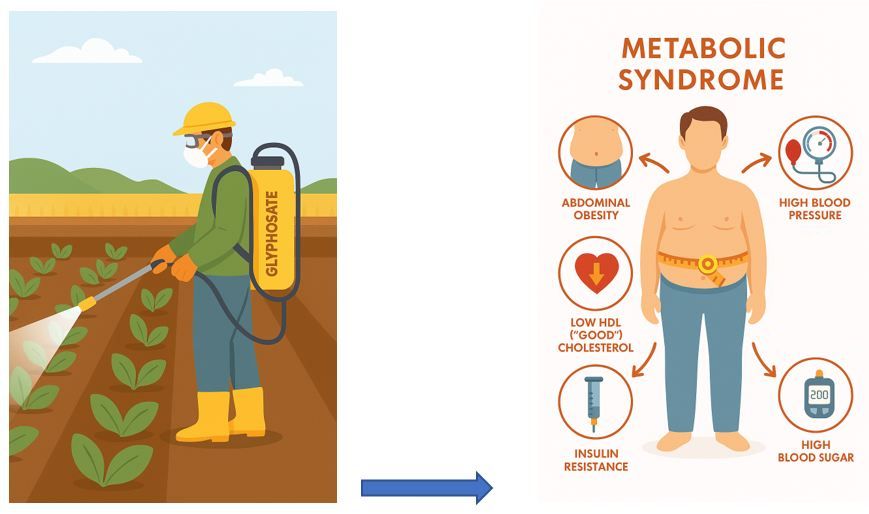
In the 1st example of HIA, based on the systematic review, we selected two population-based studies investigating the association of urinary levels of glyphosate with incidence of metabolic syndrome. The selection was based on the extracted data to find studies that were reporting on the same outcome with the same method of exposure assessment for the same pesticide. We could not find any other studies on glyphosate, AMPA or tebuconazole that had the same outcome or method. The two selected studies were the following:
1.Eskenazi, Brenda, et al. "Association of lifetime exposure to glyphosate and aminomethylphosphonic acid (AMPA) with liver inflammation and metabolic syndrome at young adulthood: findings from the CHAMACOS study." Environmental health perspectives131.3 (2023): 037001.]:
Glyphosate exposure was evaluated in the CHAMACOS prospective birth cohort (n = 480 mother–child dyads) and a nested case–control group (60 cases of elevated liver transaminases; 91 controls). Two exposure metrics were used: urinary glyphosate residues—calculated as glyphosate + 1.5 × AMPA—measured during pregnancy and at ages 5, 14, and 18; and the amount of agricultural glyphosate applied within a 1 km radius of each residence from birth to age 5. Metabolic syndrome was assessed at 18 years in the full cohort. A twofold increase in urinary glyphosate residues at age 14 was associated with an 88 % higher risk of metabolic syndrome at 18 years (RR = 1.88; 95 % CI: 1.03–3.42). Residence near agricultural glyphosate applications during early childhood was linked to a 53 % increased risk of metabolic syndrome in the nested case–control sample (RR = 1.53; 95 % CI: 1.16–2.02).
This study did not check for possible effect modification by sex (via checking the interaction term) and as a result no sex-specific associations could be determined.
2. Glover, Frank, et al. "The association between glyphosate exposure and metabolic syndrome among US adults." Human and Ecological Risk Assessment: An International Journal 29.9-10 (2023): 1212-1225:
Data from the National Health and Nutrition Examination Survey were analyzed to assess the association between urinary glyphosate concentrations and metabolic syndrome, which was defined according to American Heart Association criteria. Urinary glyphosate served as the exposure metric, and chi-square tests, analysis of variance, and multivariable weighted linear and logistic regression analyses were conducted to evaluate relationships.
A total of 338 adults were included, and the prevalence of metabolic syndrome was determined to be 19 %. When treated as a continuous variable, a two-fold increase in urinary glyphosate was associated with a 2.24-fold higher odds of metabolic syndrome (OR = 2.24; 95 % CI: 1.23–4.08). Stratification into exposure quartiles revealed progressively higher odds of metabolic syndrome in quartiles 2 through 4—OR = 1.17 (95 % CI: 0.47–2.89), OR = 1.56 (95 % CI: 0.55–4.55), and OR = 3.29 (95 % CI: 1.38–7.42), respectively—using the lowest quartile as reference.
This study did not check for possible effect modification by sex (via checking the interaction term) and as a result no sex-specific associations could be determined.
We meta-analyzed the reported OR for 1-unit increase in glyphosate from the two papers using the following syntax in R:
R Script for meta-analysis:
https://github.com/ArashDer/SPRINT-HIA/blob/main/SPRINT-WP5-HIA-meta-analysis.R
Result of the meta-analysis:
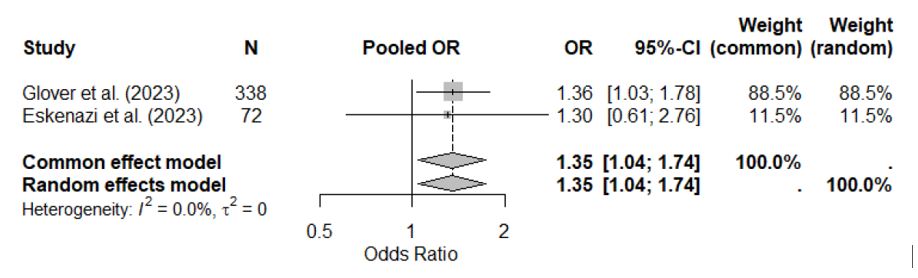
We used the random effect meta-analyzed OR (95%CI) of 1.35 (1.04 to 1.74) as the ERF for our HIA.
We estimated metabolic syndrome ( MetS ) cases in the adult population of the Netherlands, based on the prevalence of 29.2% reported in the paper by Sigit et al. 2020 (Other studies in Dutch and European populations have also reported prevalences of 20.0% [Frentz et al. 2024] and 28.2% [Pigeot et al. 2025] for metabolic syndrome in adults):
MetS Cases=14,500,000 × 0.292≈4,234,000.
The next steps towards HIA are described below:
Inputs and setup
- Baseline cases: 4,234,000 metabolic syndrome cases in the Netherlands.
- Exposure level: 0.17875 µg/L average urinary glyphosate.
- Effect estimate (beta): Natural log of the risk ratio per 1 µg/L.
1. Compute beta from the reported risk ratio
- Calculation: Beta is the natural logarithm of the risk ratio per unit exposure.
β=ln(1.35)≈0.3001
- Interpretation: This means each 1 µg/L increase in urinary glyphosate is associated with a multiplicative increase of 35 in risk; the log scale coefficient is 0.3001.
2. Calculate the risk ratio at the observed exposure level
- Calculation: Apply the log-linear model to the average exposure.
RR=eβ*exposure_level=e0.3001*0.17875≈e0.05364≈1.0551
- Interpretation: At the mean exposure of 0.17875 µg/L, the estimated risk is about 5.51% higher than baseline.
3. Compute the attributable fraction (AF)
- Calculation: AF is the proportion of cases attributable to the exposure given the estimated RR.
AF=RR−1/RR=1.0551−1/1.0551≈0.05511.0551≈0.0522
- Interpretation: Approximately 5.22% of cases are attributable to exposure at this average level.
4. Estimate the number of attributable cases
- Calculation: Multiply AF by the baseline number of cases.
Attributable cases=AF*baseline_cases=0.0522*4,234,000≈221,143
- Interpretation: About 221,143 metabolic syndrome cases are attributable to the exposure under these assumptions.
Rounded results
- Attributable fraction (AF):0522
- Attributable cases: 221,143
R script for the above calculations: https://github.com/ArashDer/SPRINT-HIA/blob/main/SPRINT_WP5_HIA_Example1_MetS.R
In the above calculation exercise, we show that the attributable cases of metabolic syndrome in the Netherlands in the year 2020 due to exposure to glyphosate could be nearly 221,143. These results should be interpreted with caution, as the current evidence base does not provide strong epidemiological support from large, well-designed human population studies. While the calculations suggest a potential burden of metabolic syndrome cases attributable to glyphosate exposure, such estimates rely on assumptions drawn from limited data and may not accurately reflect real-world risks. Without consistent findings across diverse populations (with a sex-specific approach) and robust experimental confirmation of biological mechanisms, the observed associations remain uncertain. To move beyond preliminary estimates and better understand the true health implications, more comprehensive population-based studies (with a sex-specific approach) are needed to investigate the relationship between glyphosate exposure and adverse outcomes, including metabolic diseases. The lack of epidemiological evidence is due to a limited number of studies that has been performed on this issue. The calculation exercise we show here indicates that the potential impact on public health could be very large. This is because of the combination of two things: a high prevalence of exposure (many people are exposed), in combination with a high prevalence of metabolic syndrome in the population.