
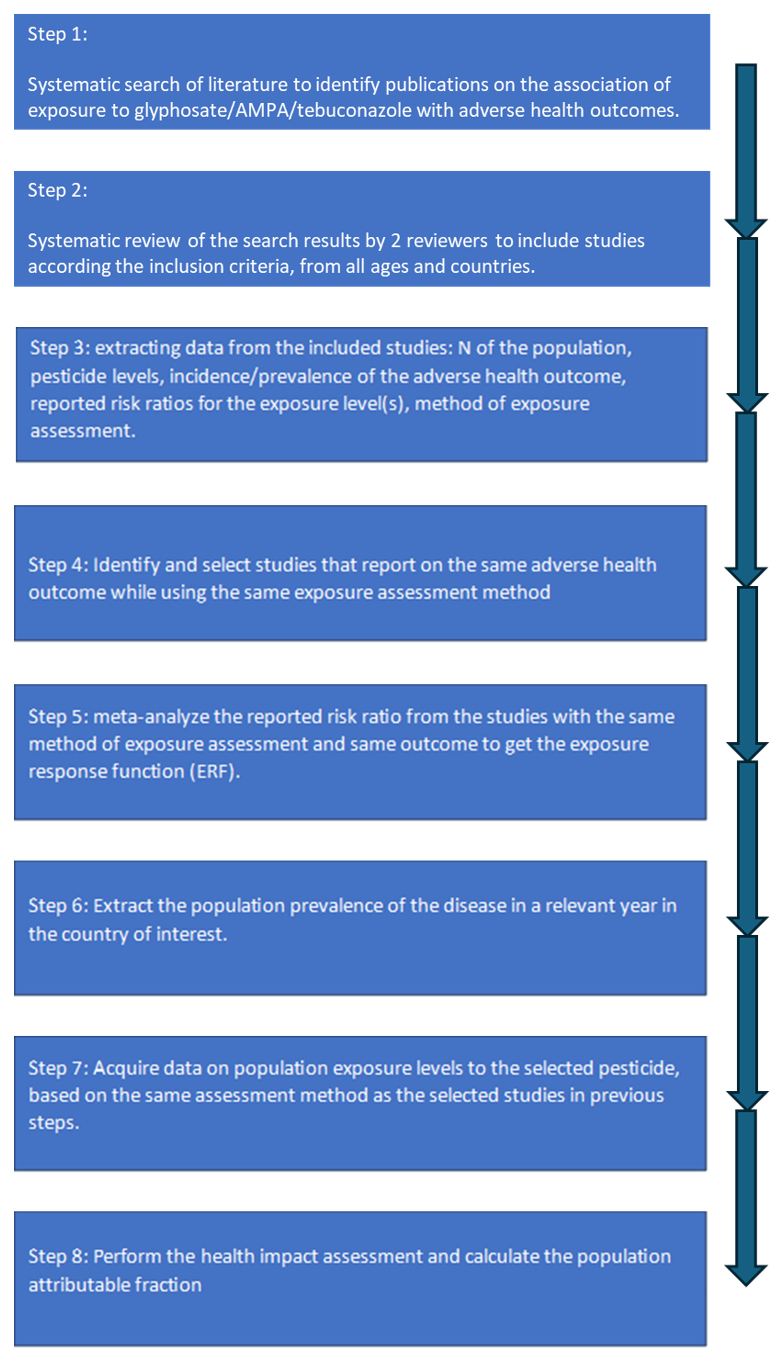
Step 1: Systematic review of literature
Systematic search of literature to identify publications on the association of exposure to glyphosate/AMPA/tebuconazole with adverse health outcomes
First, we performed a systematic review of literature to identify publications on the association of exposure to glyphosate/AMPA/Tebuconazole with adverse health outcomes. In this initial phase, we design and execute a comprehensive search across scientific databases to capture every study linking glyphosate, AMPA, or tebuconazole exposure with adverse health outcomes. We define precise search terms, date ranges, and language filters to ensure consistency and reproducibility. We catalogue all retrieved records and remove duplicates. Our goal is to assemble a full inventory of published evidence before any screening begins. The search terms used in each database is as follows:
Pubmed https://pubmed.ncbi.nlm.nih.gov :
(((((Acetamiprid OR Abamectin[Title/Abstract] OR Vertimec[Title/Abstract] OR "Tamaron Gold"[Title/Abstract] OR Asataf [Title/Abstract]OR Lancer[Title/Abstract] OR "td-2480"[Title/Abstract] OR "td-2472"[Title/Abstract]) OR (Glyphosate OR Roundup[Title/Abstract] OR Rodeo[Title/Abstract] OR Touchdown[Title/Abstract] OR KleenUp[Title/Abstract] OR Imitator[Title/Abstract] OR Eraser[Title/Abstract] OR Pronto[Title/Abstract])) OR (Tebuconazole OR Mirage[Title/Abstract] OR "Banner MAXX"[Title/Abstract] OR Alamo[Title/Abstract] OR "Propiconazole 14.3 phosphorous acid salts"[Title/Abstract] OR Alude[Title/Abstract] OR Magellan[Title/Abstract]))
AND
(("Epidemiologic Studies"[Mesh] OR epidemiolog*[Title/Abstract] OR crosssectional[Title/Abstract] OR cross sectional[Title/Abstract] OR cohort[Title/Abstract] OR case control[Title/Abstract])))
AND
(("Neoplasms"[Mesh] OR "Kidney Diseases"[Mesh] OR "Lung Diseases"[Mesh] OR "Heart Diseases"[Mesh] OR "Endocrine System Diseases"[Mesh] OR "Nervous System Diseases"[Mesh] OR "Reproductive Health"[Mesh] OR disease*[Title/Abstract] OR chronic*[Title/Abstract] OR neurological[Title/Abstract] OR reproductive[Title/Abstract] OR cancer[Title/Abstract] OR neoplasm*[Title/Abstract] OR diabetes[Title/Abstract] OR respiratory[Title/Abstract] OR kidney[Title/Abstract]))) NOT (("Animals"[Mesh] NOT "Humans"[Mesh]))
Web of science https://www.webofscience.com/wos/woscc/smart-search :
TS=((Acetamiprid OR Abamectin OR Vertimec OR "Tamaron Gold" OR Asataf OR Lancer OR "td-2480” OR "td-2472") OR (Glyphosate OR Roundup OR Rodeo OR Touchdown OR KleenUp OR Imitator OR Eraser OR Pronto) OR (Tebuconazole OR Mirage OR "Banner MAXX" OR Alamo OR "Propiconazole 14.3 phosphorous acid salts" OR Alude OR Magellan)) AND TS=((Disease* OR chronic* OR cancer OR neoplasm* OR neurological OR diabetes OR reproductive OR respiratory OR kidney ) ) AND TS=((epidemiolog* OR crosssectional OR cross sectional OR cohort OR case control))
Embase https://www.embase.com/ :
(('neoplasm'/exp OR 'heart disease'/exp OR 'lung disease'/exp OR 'kidney disease'/exp OR 'neurologic disease'/exp OR 'endocrine disease'/exp OR 'genital system disease'/exp OR disease*:ab,ti,kw OR chronic*:ab,ti,kw OR cancer:ab,ti,kw OR neurological:ab,ti,kw OR neoplasm*:ab,ti,kw OR diabetes:ab,ti,kw OR reproductive:ab,ti,kw OR respiratory:ab,ti,kw OR kidney:ab,ti,kw) AND ('acetamiprid'/exp OR 'tebuconazole'/exp OR 'glyphosate'/exp OR acetamiprid:ab,ti,kw OR abamectin:ab,ti,kw OR vertimec:ab,ti,kw OR 'tamaron gold':ab,ti,kw OR asataf:ab,ti,kw OR lancer:ab,ti,kw OR 'td-2480':ab,ti,kw OR 'td-2472':ab,ti,kw OR glyphosate:ab,ti,kw OR roundup:ab,ti,kw OR rodeo:ab,ti,kw OR touchdown:ab,ti,kw OR kleenup:ab,ti,kw OR imitator:ab,ti,kw OR eraser:ab,ti,kw OR pronto:ab,ti,kw OR tebuconazole:ab,ti,kw OR mirage:ab,ti,kw OR 'banner maxx':ab,ti,kw OR alamo:ab,ti,kw OR 'propiconazole 14.3 phosphorous acid salts':ab,ti,kw OR alude:ab,ti,kw OR magellan:ab,ti,kw) AND ('epidemiology'/exp OR epidemiolog*:ab,ti,kw OR crosssectional:ab,ti,kw OR 'cross sectional':ab,ti,kw OR cohort:ab,ti,kw OR 'case control':ab,ti,kw)) NOT ('animal'/exp NOT 'human'/exp)
Step 2: Systematic review of the search results
Systematic review of the search results by 2 reviewers to include studies according to the inclusion criteria, from all ages and countries
Two independent reviewers screen titles and abstracts against predefined inclusion and exclusion criteria (see below), considering populations of all ages and geographic regions:
Include:
- Epidemiological studies with quantitative exposure estimate (objective measurements, modelling based on objective measurements, job/crop exposure matrices) on Acetamiprid, Glyphosate, or Tebuconazole (or synonyms) and chronic non-communicable disease (Cancer, Kidney Diseases, Lung Diseases, Heart Diseases, Endocrine Diseases, Nervous System (neurological) Diseases, and reproductive health).
- Studies of all age groups.
- Studies with a comparator (low or no exposed as reference/control group)
- Studies published in any year and by default in English – studies written in other languages than English will be explored to some extent.
Exclude:
- Studies on acute toxicity, most importantly acute intoxication.
- Studies with subjective or qualitative exposure data measures (e.g., self-reported exposures from workers) – BUT with one exception – we included studies from the Agricultural Health Study.
- Studies on symptoms.
- Uncontrolled before-and-after studies, qualitative studies, case studies and non-original studies.
Each reviewer flags studies for potential relevance, then they compare decisions to identify and resolve discrepancies. This dual process minimizes bias and ensures that no pertinent study is overlooked. The outcome is a curated list of studies meeting basic quality and scope requirements.
Types of exposure: We included studies that have investigated one or more of the following three pesticides: Acetamiprid (or synonyms: Abamectin, Vertimec, Tamaron Gold, Asataf, Lancer, td-2480, td-2472); Glyphosate (or synonyms. Roundup, Rodeo, Touchdown, KleenUp, Imitator, Eraser, Pronto); Tebuconazole (or synonyms: Mirage, Banner MAXX, Alamo, Propiconazole 14.3 phosphorous acid salts, Alude, Magellan)
Included studies:
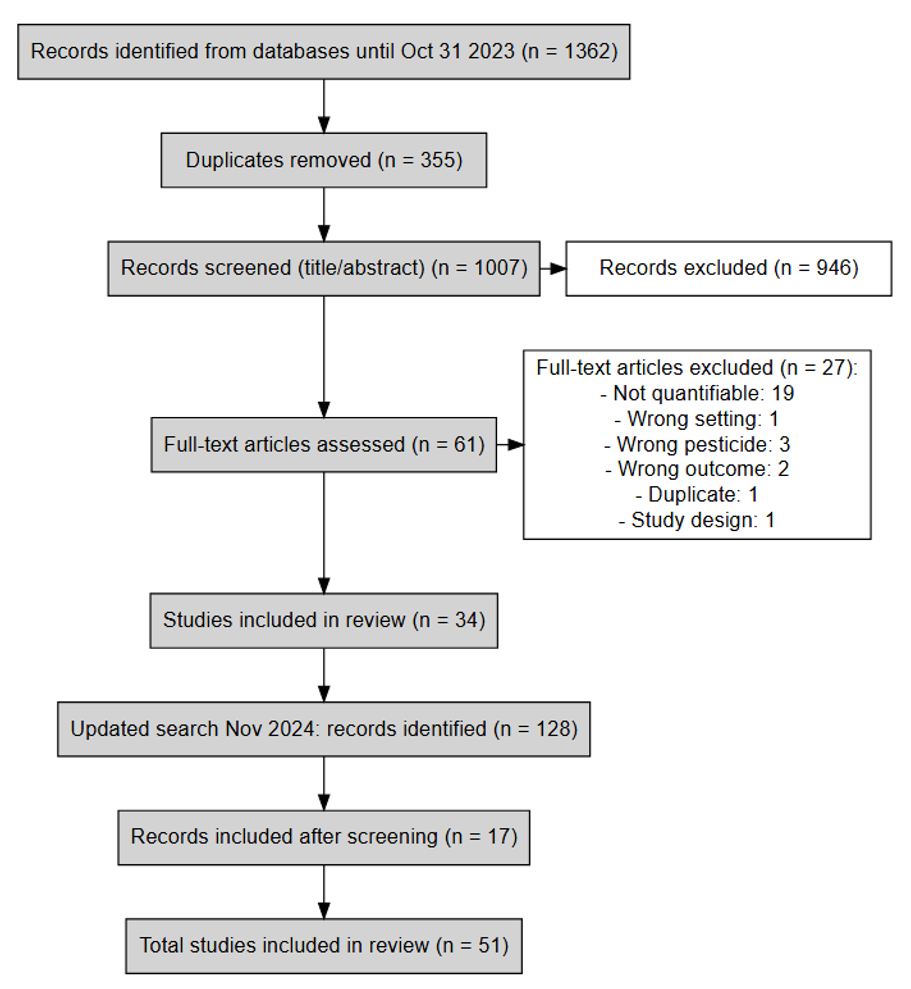
We identified 1362 papers, they were imported to Covidence, and after excluding 355 duplicates we performed title/abstract screening on 1007 papers. 946 papers were excluded; thus 61 papers were full text screened. 27 papers were excluded during full text screening (19 not quantifiable, 1 wrong setting, 3 wrong pesticide, 2 wrong outcome, 1 duplicate, and one study design). Eventually 34 papers were extracted. The search was updated in November 2024 to identify newly published studies. We identified 128 newly published studies, from which based on title and abstract screening, we included 17 additional studies.
Below is the flowchart of study selection:
Step 3: Data extraction
Extracting data from the included studies: N of the population, pesticide levels, incidence/prevalence of the adverse health outcome, reported risk ratios for the exposure level(s), method of exposure assessment
From each included publication, we systematically extract key information: sample size, measured pesticide concentrations, participant selection criteria, reported risk ratios for defined exposure levels, and the specific exposure assessment method. We enter data into a standardized extraction form. This step transforms narrative and tabular results into a harmonized dataset ready for analysis.
Step 4: Identify and select studies that report on the same adverse health outcome while using the same exposure assessment method
Identify and select studies that report on the same adverse health outcome while using the same exposure assessment method
To enable valid pooling, we isolate studies addressing the same health endpoint and using identical exposure assessment techniques. For example, we might only advance studies measuring glyphosate in urine via LC-MS/MS that report incidence of non-Hodgkin lymphoma. Aligning outcomes and methods ensures the exposure–response relationships derived later rest on truly comparable data.
Step 5: Meta-analyze the reported risk ratio from the studies with the same method of exposure assessment and same outcome
Meta-analyze the reported risk ratio from the studies with the same method of exposure assessment and same outcome to get the exposure response function (ERF)
We pool the results of the selected studies through meta-analytic techniques to calculate a pooled risk ratio per unit of pesticide exposure. We choose fixed- or random-effects models based on heterogeneity and perform sensitivity analyses to test robustness. The resulting exposure–response function quantifies how incremental changes in exposure translate into changes in disease risk.
Step 6: calculate Population Attributable Fraction (PAF)
Extract the population prevalence of the disease in a relevant year in the country of interest
The PAF is the proportional reduction in disease incidence that would occur if exposure to the risk factor was reduced or increased to an alternative ideal exposure scenario. In order to calculate the PAF we take the following steps:
1. Quantify Population Exposure Distribution
We compile population-level exposure data using the same assessment method as the ERF studies. This produces a distribution of exposure levels across individuals or subgroups in the target population.
2. Obtain Baseline Disease Prevalence
We gather epidemiological data on the current prevalence or incidence of the health outcome from national registries or surveys. These figures serve as the baseline for estimating cases attributable to exposure. We can use previously published data on incidence/prevalence of the disease in the target country, or use data from national/government databases on diseases. In the Netherlands, the https://www.vzinfo.nl/ website contains the data on incidence and prevalence of most diseases in the Netherlands.
3. Select the PAF Formula:
We use the following formula to calculate the PAF:
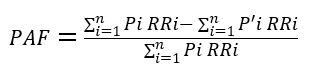
Pi = proportion of population at exposure level i , current exposure
P'i = proportion of population at exposure level i, recommended level of exposure
RRi = the relative risk at exposure level i
n = the number of exposure levels
OR if the exposed proportion of the population is 100%: PAF= (RR-1)/RR
4. Compute Attributable Fraction and Cases
We calculate the PAF using the chosen formula and then multiply PAF by the total number of cases to estimate attributable cases. This quantifies the burden that could be prevented under a specified reference exposure. Because the chosen pesticide exposure could in theory be entirely prevented, we selected here a “zero exposure” scenario as our referent.