
Example: HIA of glyphosate for atrial septal defect:
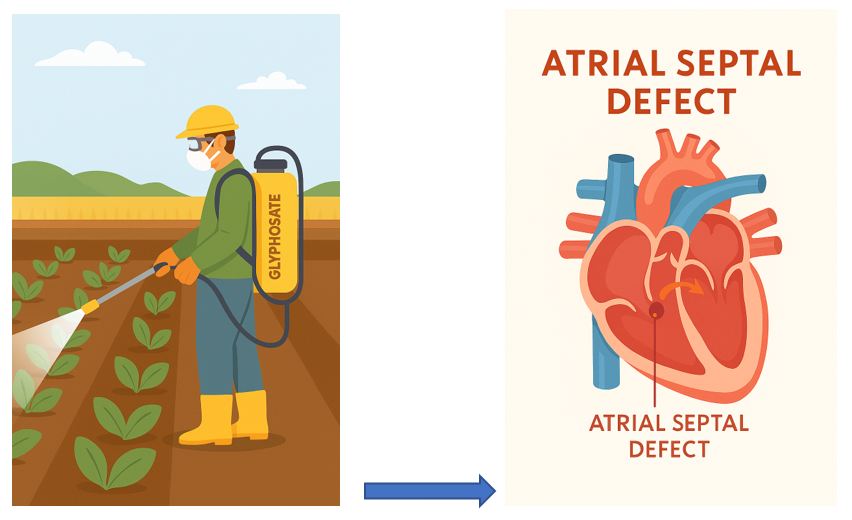
Step 1: Defining the Health Outcome and Exposure Categories and Data Extraction
A systematic review of literature (and data extraction) was performed by two reviewers to identify epidemiologic studies reporting on adverse health outcomes of exposure to glyphosate. Based on quality of data, significance of results and method of exposure assessment, we decided to use the odds ratios (OR) reported by Rappazzo et al 2018 for percentiles of sum of pounds of glyphosate applied to any crop in 500 meter buffer during exposure window, with the target population of pregnant women and health outcome of atrial septal defect.
|
Groups |
N control (%) |
N ASD (%) |
OR (95%CI) |
|
|
Glyphosate |
unexposed=reference |
165,996 (56) |
514 (50) |
ref |
|
<10th percentile |
13,282(4) |
45 (4) |
1.12 (0.82, 1.52) |
|
|
10-50th percentile |
53,432(18) |
186 (18) |
1.14 (0.96, 1.35) |
|
|
50th-90th percentile |
52,642 (18) |
203 (20) |
1.24 (1.06, 1.46) |
|
|
>90th percentile |
13,196 (4) |
72 (7) |
1.72 (1.35, 2.21) |
It should be noted that this study have not considered possible foetal sex-specific associations.
We contacted the author to acquire the corresponding levels of glyphosate for each percentile in pounds and converted the number to kilograms (kg):
|
Groups |
Dose in pounds |
Dose in kg |
|
|
Glyphosate |
unexposed=reference |
0 |
|
|
<10th percentile |
0 < to <= 0.12463 |
0 to 0.057 |
|
|
10-50th percentile |
0.12463 < to <= 1.38832 |
0.57 to 0.63 |
|
|
50th-90th percentile |
1.38832 < to <= 20.9386 |
0.63 to 9.5 |
|
|
>90th percentile |
> 20.9386 |
> 9.5 |
Step 2:
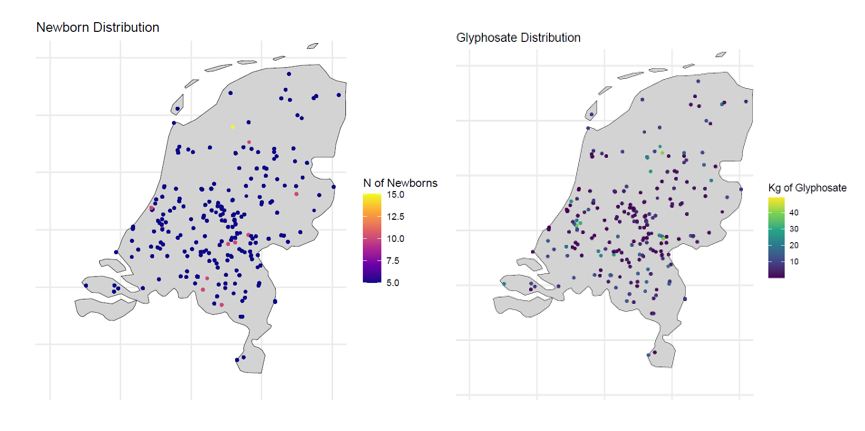
We acquired the sum of kg of glyphosate applied to any crop in 500-meter buffer in 2020 for any grin in the Netherlands (N of grids= 2,256,482). Then we acquired the number of newborns within each grid in the Netherlands in 2020 and merged the two files (N of grids=9,144). The subset of grids with newborns in 2020 includes 1,141,440 total residents with N= 48,380 newborns.
In order to merge the information of number of newborns per grid, we downloaded the freely available data on this from CBS, and merge the data based on coordinates with the exposure file [https://www.cbs.nl/nl-nl/dossier/nederland-regionaal/geografische-data/kaart-van-100-meter-bij-100-meter-met-statistieken .
The R script below shows the steps of merging
https://github.com/ArashDer/SPRINT-HIA/blob/main/SPRINT_WP5_HIA_Example2_merging_exposure_population.R
Below are the maps of newborns N in the Netherlands in 2020 and the distribution of glyphosate exposure:
Step 3: We applied the glyphosate cut-offs based on Rappazzo et al 2018 to our measured glyphosate exposure:
|
Glyphosate Dose in kg |
N (%) of newborns |
|
unexposed |
200 (0.4) |
|
0 to 0.057 |
1570 (3.1) |
|
0.57 to 0.63 |
8255 (17.4) |
|
0.63 to 9.5 |
28060 (59.2) |
|
> 9.5 |
10295 (19.9) |
Step 4: Calculate the Attributable Fraction (AF)
Based on the reported ORs, calculated the Population Attributable Fraction (PAF) based on the following formula:
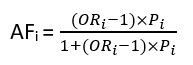
Where:
ORi: Odds ratio for exposure category i relative to the reference group (no exposure).
Pi: Proportion of the population in the exposure category.
The PAFs according to each glyphosate exposure group in our population was the following:
|
Dose in kg |
PAF % |
|
0 to 0.057 |
0.37 |
|
0.57 to 0.63 |
2.36 |
|
0.63 to 9.5 |
12.5 |
|
> 9.5 |
12.5 |
Step 5: Calculate the Total Population Attributable Fraction (PAF)
Then we calculated the overall PAF based on the following formula:
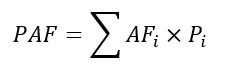
Where:
AFi: Attributable Fraction for each category of glyphosate exposure.
Pi: Proportion of the population in exposure categories of glyphosate.
Overall PAF= 0.103
Step 6: Estimate the Impact on Health Outcome
The incidence of ASD in the Netherlands according to https://www.vzinfo.nl/aangeboren-afwijkingen-van-hartvaatstelsel/leeftijd-en-geslacht/geboorteprevalentie is 6 per 10,000 live births per year.
N of newborns in 2020 in our file is 48,380, thus expected cased of ASD in 2020 in our file= 48380 * (6/10000)= 29 expected cased of ASD
We calculated the attributable cases of ASD due to exposure to glyphosate based on the following:
Attributable cases=PAF×Total cases of ASD in the population
Attributable cases= 0.103 *29 =3 cases of ASD per year
R script to perform steps 3-6:https://github.com/ArashDer/SPRINT-HIA/blob/main/SPRINT_WP5_HIA_Example2_steps_3_6.R
In this example we show that there could be 3 possible cases of ASD among newborns due to maternal exposure to glyphosate in the Netherlands in year 2020. The same as example 1, these findings should be viewed with caution, as the current body of evidence does not provide strong epidemiological confirmation from large-scale, well-conducted human studies. Although the calculations point to a possible contribution of glyphosate exposure to the occurrence of atrial septal defects, such estimates are based on limited data and rest on assumptions that may not accurately capture real-world risks. In the absence of consistent results across diverse populations and without solid experimental evidence to clarify biological mechanisms, the suggested associations remain speculative. To gain a clearer understanding of potential health effects, more rigorous population-based as well as sex-specific research is needed to examine the link between glyphosate exposure and adverse outcomes, including congenital heart defects such as atrial septal defect.