
Description
What type of agriculture is being studied in Denmark?
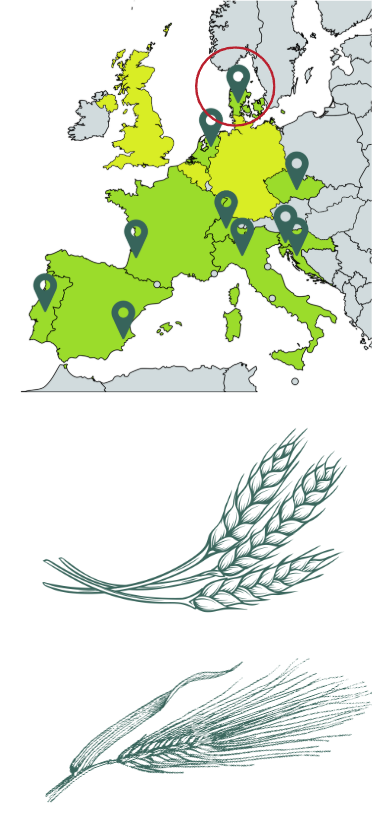 Winter wheat and spring barley
What are the main characteristics of the site?
Over half of Danish land is agricultural (61%), with farms on average, spanning 77ha. The main crops grown in Denmark are cereals, 3/4 of which are used to feed livestock, including pigs, cattle, and poultry.
The case study site for SPRINT will be located in the central Denmark region which has fertile soils, forests, lakes, and streams.
When are pesticides applied?
On winter wheat, herbicides are applied in October/December and April/Mary, whilst fungicides are applies in May/June. On spring barley, herbicides are applied from April-May whilst fungicides are applied in June-July.
Which pesticides are relied on the most in the area?
Glyphosate is the most heavily relied upon pesticide by conventional farmers in Denmark.
Sample numbers
Both conventional and organic systems contributed to the farming system. For example, ‘Cat Organic’ refers to a cat sampled from an organic farm.
| Environment (total 78 samples ) | |
|---|---|
| Soil Conventional | 10 |
| Soil Organic | 10 |
| Crop Conventional | 10 |
| Crop Organic | 9 |
| Air outdoor Conventional | 1 |
| Air outdoor Organic | 1 |
| Indoor dust Conventional | 5 |
| Indoor dust Organic | 6 |
| Earthworm Conventional | 10 |
| Earthworm Organic | 10 |
| Water | 3 |
| Sediment | 3 |
| Human (total 231 samples) | |
|---|---|
| Conventional farmer Male | 23 |
| Conventional farmer Female | 15 |
| Organic farmer Male | 28 |
| Organic farmer Female | 20 |
| Neighbour Male | 33 |
| Neighbour Female | 32 |
| Consumer Male | 39 |
| Consumer Female | 41 |
| Animal (total 164 samples) | |
|---|---|
| Cow Conventional | 79 |
| Cow Organic | 80 |
| Cat Conventional | 3 |
| Cat Organic | 2 |
Explanation of the figure
The ‘heatmap’ figures show the relative pesticide content in environmental, human or animal matrices. Select a tab from “Environment”, “Human” or “Animal” to explore the detailed content of each compartment. Name of the matrices are displayed in the lower light grey bars (X-axis), where the X-axis are labeled with different categories of sampling stratified by farm management types, human characteristics, animal types and/or sex, etc.
- Color legend: the darker the purple squares are, the higher the pesticide concentration is. Light orange means ‘tested & not detected (<LOD)'
- X-axis labels:
- Environment:
- CF: Conventional farm.
- OF: Organic farm.
- Human:
- F_CF: Female (F) conventional (C) farmer (F).
- M_CF: Male (M) conventional (C) farmer (F).
- F_OF: Female (F) Organic (O) farmer (F).
- M_OF: Male (M) Organic (O) farmer (F)
- F_Neighbour: Female (F) neighbour.
- M_Neighbour: Male (M) neighbour.
- F_Consumer: Female (F) consumer.
- M_ Consumer: Male (M) consumer.
- Animal:
- CF: Conventional farm.
- OF: Organic farm.
- Environment:
The different compounds are listed on the Y - axis, classified according to the pesticide type and EU approval status in 2021:
- A-I: Approved insecticide
- A-H: Approved herbicide
- A-F: Approved fungicide
- A_MT: Approved metabolite
- NA-I: Not approved insecticide
- NH: Not approved herbicide
- NA-F: Not approved fungicide
- NA_MT: Not approved metabolite
- S: Synergist
- UM: Urine metabolite
By clicking on the columns of different matrices or country names, for example: “Urine”, or “Denmark”. You will be directed to the country x matrix page where detailed statistics on three levels of information are revealed in this page:
- Most frequently detected compounds in a matrix in a specific country with its median concentration.
- Number of compounds tested and detected according to their approval status (Approved, Not approved, CfS (candidate for substitution) or synergist) in a matrix in a specific country.
- Number and total concentration of pesticide detected in each sample in the matrix in the country.
Environment
Human
Animal