DISCLAIMER: The tools, as they currently stand, are provided for research and informational purposes only. The underlying models, assumptions, data sources, and methodologies are experimental and might have not yet been peer-reviewed or independently validated. Outputs may be incomplete, uncertain, or inaccurate and should be interpreted with caution. The tools do not provide regulatory, medical, legal, toxicological, or professional risk assessment advice. For the time being, it must not be used as a substitute for expert judgment, regulatory review, or established risk-assessment frameworks, nor relied upon for decision-making related to human health, environmental protection, occupational safety, product registration, compliance, or policy.
Use of these tools for unlawful, harmful, misleading, or unethical purposes—including but not limited to regulatory circumvention, misrepresentation of risk, or inappropriate application to real-world pesticide use decisions—is strictly prohibited. The tool is provided “as is,” without warranties of any kind, express or implied, including but not limited to accuracy, fitness for a particular purpose, or non-infringement.
CSS Matrices
Within the SPRINT project, samples were collected across 11 case study sites, 10 in Europe and 1 in Argentina. The sampling campaign was conducted during the 2021 growing season. A total of 4609 samples, from environmental, animal, and human matrices, were analysed for 209 pesticide active substances .
The matrices were grouped into three main categories:
1. Environmental matrices
These represent the different environmental compartments that can be exposed to pesticides. Samples included soil, sediment, water, outdoor dust, indoor dust, crops, and earthworms.
2. Animal matrices
Samples from farm animals such as goats, pigs, chickens, dairy cows, and sheep were analysed. The matrices included blood plasma, urine, stool, milk, feed, and wristbands.
3. Human matrices
Samples were collected from farmers, neighbours, and consumers living near or within agricultural areas. The analysed matrices included blood plasma, urine, stool, and wristbands.
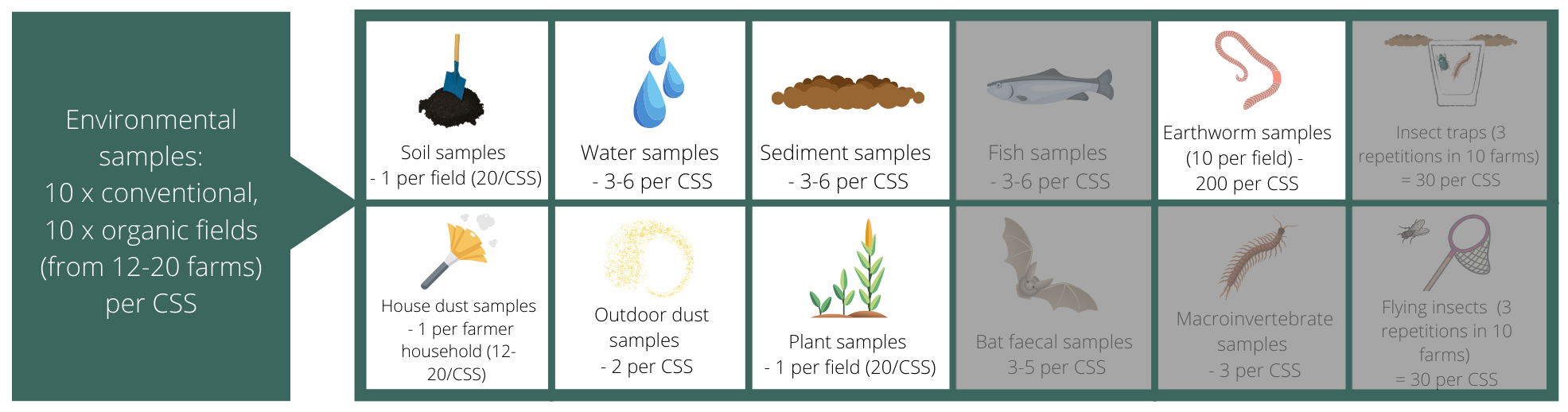
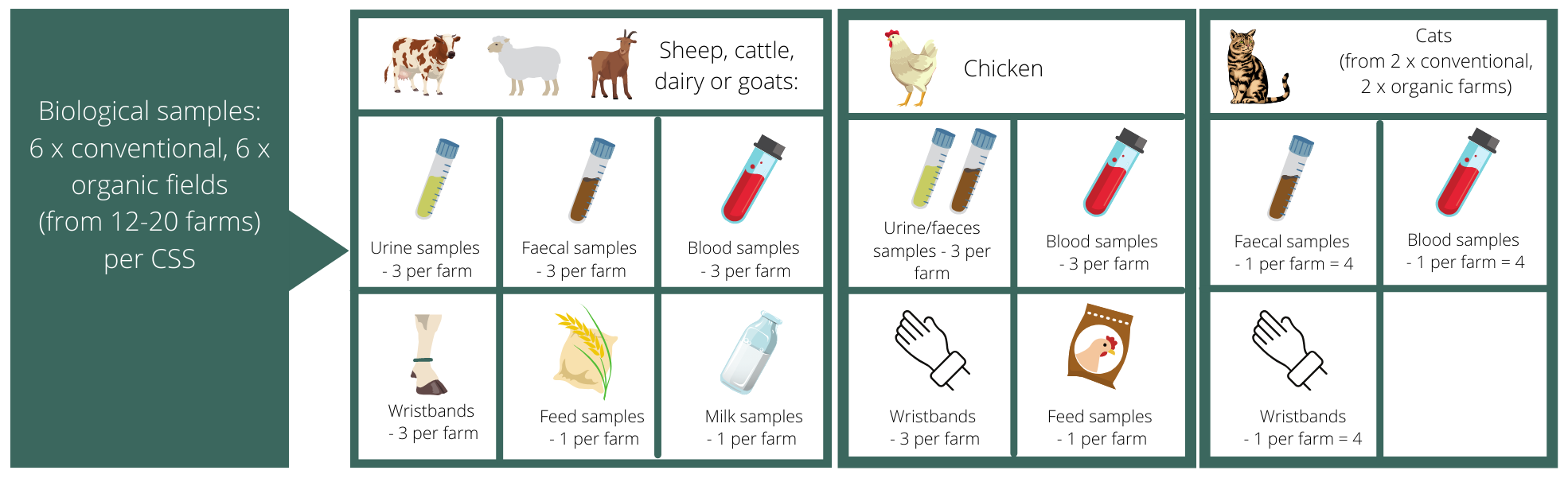
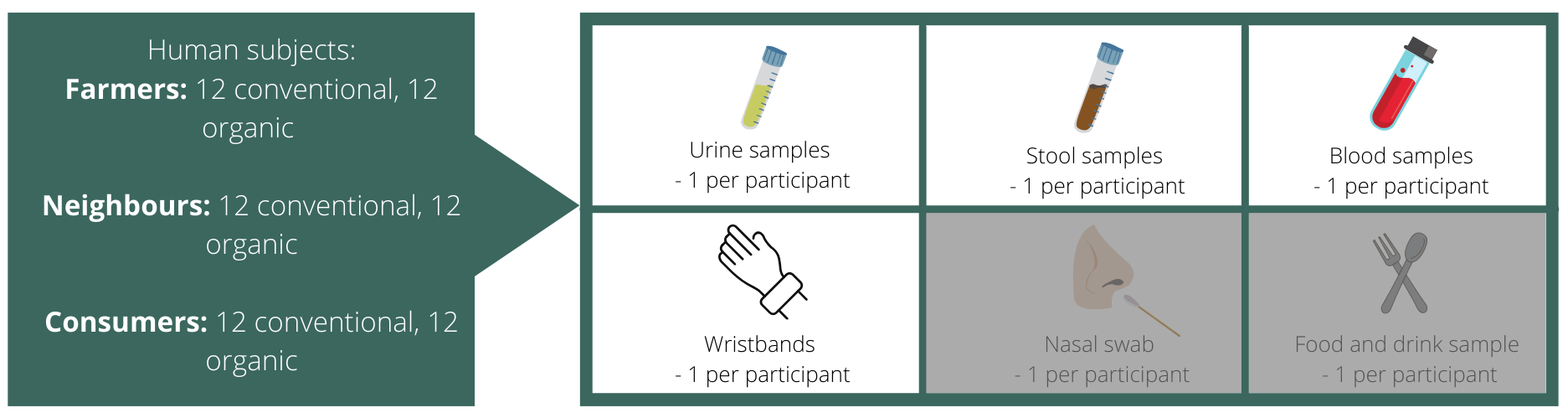
Grey blocks indicate samples from the SPRINT campaign that are not represented in this tool (mostly samples used for diversity or microbiome studies only).