
We collected various types of environmental samples to obtain a holistic overview of pesticide levels across the landscapes of our case study sites. The figure below illustrates the design of our sampling campaign.
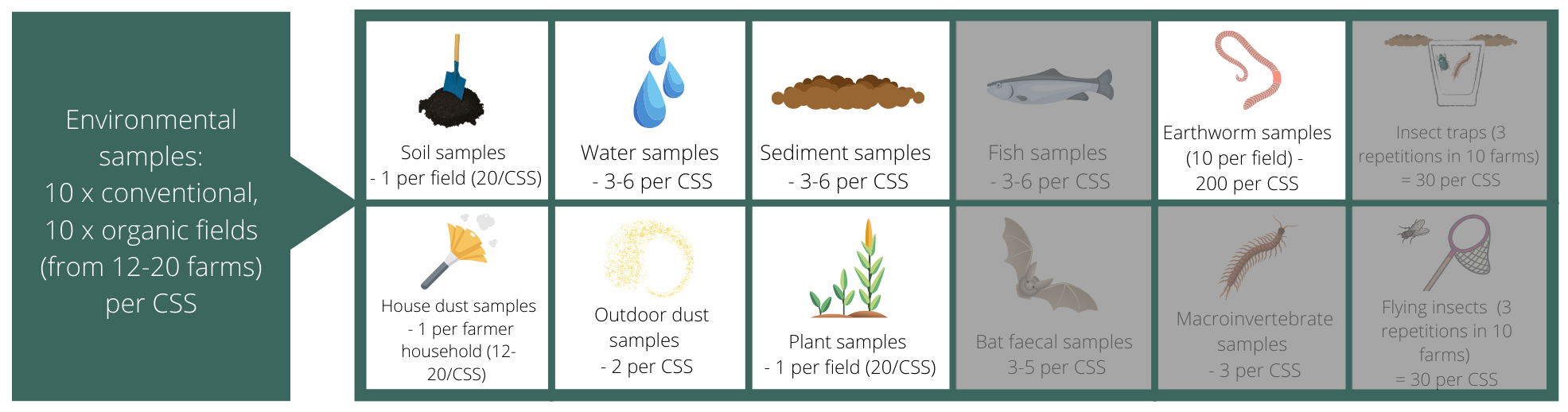
Grey blocks indicate samples from the SPRINT campaign that are not represented in this tool (mostly samples used for diversity or microbiome studies only).
Soil, water, sediment, indoor dust, and outdoor air samples were collected in the middle of the growing season, while crops were collected at harvest time. The middle of the growing season corresponded to the period when most pesticide applications for the year had already been completed. This timing varied across case study sites (CSS), depending on specific crop-region timelines. For most CSS, this corresponded to the end of May to early June. For CSS2 and CSS5, with a later growing season, this period occurred in September to October.
More detailed information about the sampling time and methodology can be found in:
- Silva, V., Gai, L., Harkes, P., Tan, G., Ritsema, C. J., Alcon, F., Contreras, J., Abrantes, N., Campos, I., Baldi, I., Bureau, M., Christ, F., Mandrioli, D., Sgargi, D., Pasković, I., Polić Pasković, M., Glavan, M., Hofman, J., Huerta Lwanga, E., . . . Geissen, V. 2023. Pesticide residues with hazard classifications relevant to non-target species including humans are omnipresent in the environment and farmer residences. Environment International, 181, 108280. https://doi.org/10.1016/j.envint.2023.108280.
- Alaoui, A., Christ, F., Silva, V., Vested, A., Schlünssen, V., González, N., Gai, L., Abrantes, N., Baldi, I., Bureau, M., Harkes, P., Norgaard, T., Navarro, I., De la Torre, A., Sanz, P., Martínez, M. Á., Hofman, J., Pasković, I., Pasković, M. P., . . . Geissen, V. 2024. Identifying pesticides of high concern for ecosystem, plant, animal, and human health: A comprehensive field study across Europe and Argentina. Science of The Total Environment, 948, 174671. https://doi.org/10.1016/j.scitotenv.2024.174671.