
Ecological risks were assessed to understand the potential impact of pesticide residues detected in the soil and water samples in the CSS. For this, we used the conventional approach when risk quotient (RQ) is calculated for a given site as the ratio between exposure and ecotoxicity (European Environment Agency, U.S. Environmental Protection Agency). Thus, we divided the concentration of each pesticide measured in soil or water by NOEC (No Observed Effect Concentration) values for selected soil or water organisms. For each sample, the RQ values of the detected pesticides were summed to calculate the cumulative risk quotient (∑RQ), as shown in the figure below.
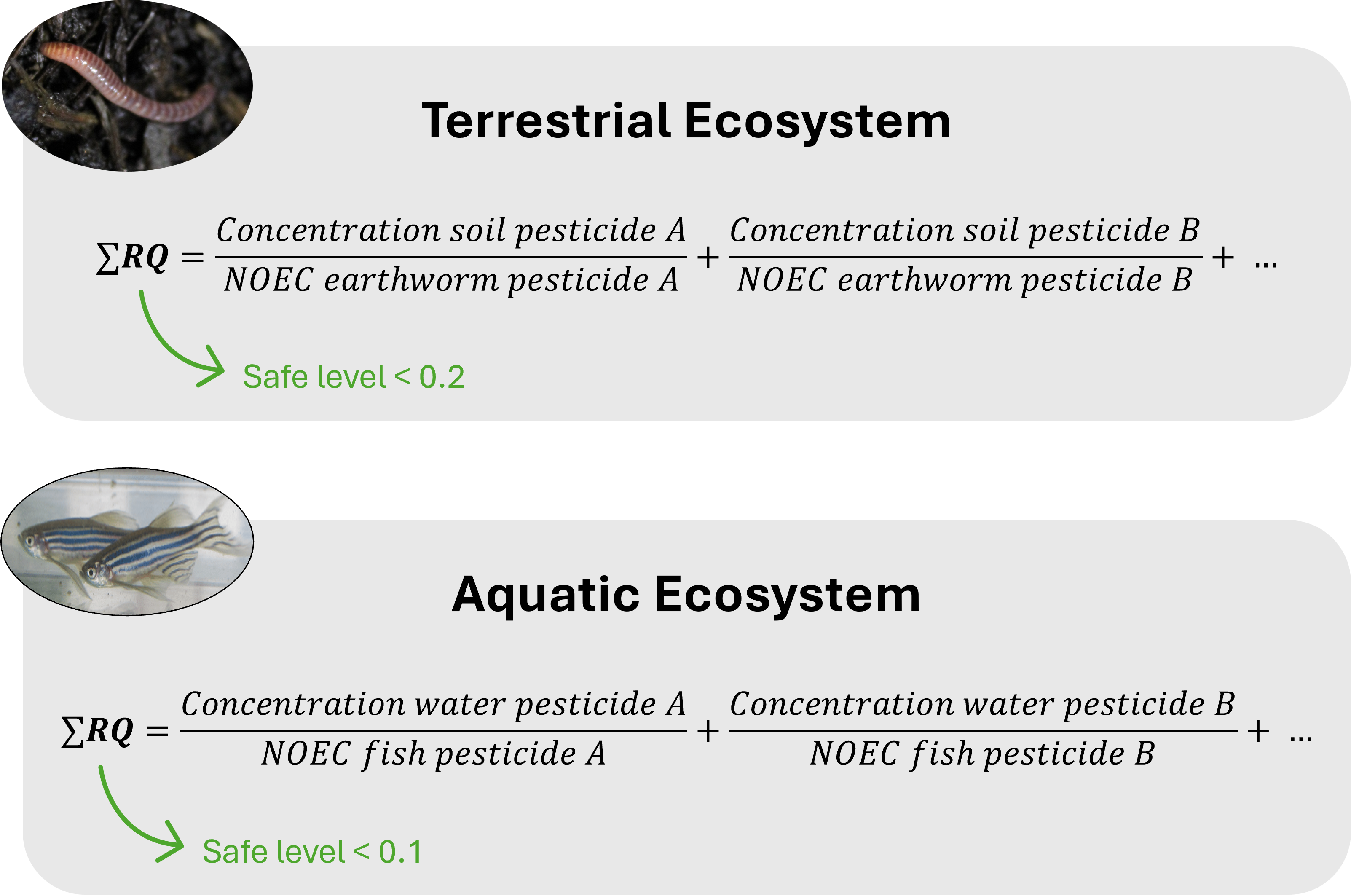
The NOEC represents a concentration at which a pesticide is not expected to cause any adverse effects on a given organism. Chronic NOEC values for earthworms and fish were sourced from the PPDB (Pesticide Properties Database).
According to EU regulation for evaluation and authorization of plant protection products, the NOEC should be considerably higher than the environmental exposure concentration to ensure species safety. Specifically:
- For earthworms, the concentration in soil must be at least five times lower than the NOEC.
- For fish, the concentration in water must be at least ten times lower than the NOEC.
Therefore, the ‘safe levels’ for the risk quotient are < 0.2 for the terrestrial ecosystem and < 0.1 for the aquatic ecosystem. Risk quotients above these values may indicate a potential for ecological harm.