
Description
What type of agriculture is being studied in Portugal?
 Viticulture (grapes for wine)
What are the main characteristics of the site?
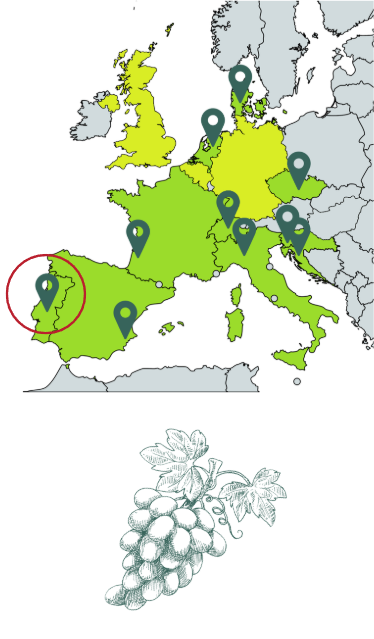
This case study is located in the Bairrada Region of Portugal. The climate here is Mediterranean with mild, wet winters and warm, dry summers. The average annual rainfall and temperature in the region is 925 mm and 15.7 °C. The dominant land use in this region is for vineyards (≈6500ha). The remaining area is covered by maritime pine plantations, annual rain-fed crops (e.g., corn, potato) and pastures, eucalypt plantations and mixed (pine and eucalypt) forests. Most of the farming systems are small to medium in size with most adopting integrated production with minimum tillage and regulated application of fertilizers and phytosanitary treatments.
When are pesticides applied?
The growing season for vineyards is all year round, but PPPs are typically applied between March-July.
Which pesticides are relied on the most in the area?
Conventional vineyard farmers use several PPPs. The most commonly used in the case study area appear to be glyphosate, cymoxanil, folpet, and azoxystrobin. Organic farmers, meanwhile, apply copper sulphate, sulphur, and mineral oils.
Sample numbers
Both conventional and organic systems contributed to the farming system. For example, ‘Cat Organic’ refers to a cat sampled from an organic farm.
| Environment (total 82 samples ) | |
|---|---|
| Soil Conventional | 12 |
| Soil Organic | 8 |
| Crop Conventional | 12 |
| Crop Organic | 8 |
| Air outdoor Conventional | 1 |
| Air outdoor Organic | 1 |
| Indoor dust Conventional | 5 |
| Indoor dust Organic | 1 |
| Earthworm Conventional | 10 |
| Earthworm Organic | 8 |
| Water | 8 |
| Sediment | 8 |
| Human (total 273 samples) | |
|---|---|
| Conventional farmer Male | 24 |
| Conventional farmer Female | 27 |
| Organic farmer Male | 24 |
| Organic farmer Female | 16 |
| Neighbour Male | 40 |
| Neighbour Female | 46 |
| Consumer Male | 36 |
| Consumer Female | 60 |
| Animal (total 31 samples) | |
|---|---|
| Chicken Conventional | 12 |
| Chicken Organic | 1 |
| Pig Conventional | 14 |
| Cat Conventional | 7 |
Explanation of the figure
The ‘heatmap’ figures show the relative pesticide content in environmental, human or animal matrices. Select a tab from “Environment”, “Human” or “Animal” to explore the detailed content of each compartment. Name of the matrices are displayed in the lower light grey bars (X-axis), where the X-axis are labeled with different categories of sampling stratified by farm management types, human characteristics, animal types and/or sex, etc.
- Color legend: the darker the purple squares are, the higher the pesticide concentration is. Light orange means ‘tested & not detected (<LOD)'
- X-axis labels:
- Environment:
- CF: Conventional farm.
- OF: Organic farm.
- Human:
- F_CF: Female (F) conventional (C) farmer (F).
- M_CF: Male (M) conventional (C) farmer (F).
- F_OF: Female (F) Organic (O) farmer (F).
- M_OF: Male (M) Organic (O) farmer (F)
- F_Neighbour: Female (F) neighbour.
- M_Neighbour: Male (M) neighbour.
- F_Consumer: Female (F) consumer.
- M_ Consumer: Male (M) consumer.
- Animal:
- CF: Conventional farm.
- OF: Organic farm.
- Environment:
The different compounds are listed on the Y - axis, classified according to the pesticide type and EU approval status in 2021:
- A-I: Approved insecticide
- A-H: Approved herbicide
- A-F: Approved fungicide
- A_MT: Approved metabolite
- NA-I: Not approved insecticide
- NH: Not approved herbicide
- NA-F: Not approved fungicide
- NA_MT: Not approved metabolite
- S: Synergist
- UM: Urine metabolite
By clicking on the columns of different matrices or country names, for example: “Urine”, or “Denmark”. You will be directed to the country x matrix page where detailed statistics on three levels of information are revealed in this page:
- Most frequently detected compounds in a matrix in a specific country with its median concentration.
- Number of compounds tested and detected according to their approval status (Approved, Not approved, CfS (candidate for substitution) or synergist) in a matrix in a specific country.
- Number and total concentration of pesticide detected in each sample in the matrix in the country.
Environment
Human
Animal