
Key ideas based on EFSA guidelines (EFSA, 2019)
- Grouping chemicals: Pesticides are grouped if they have similar toxic effects or act in the same way.
- Dose addition: If grouped chemicals act similarly, their toxic effects are added together.
- Chemical interactions (like synergy) are considered, but not assumed unless proven.
- Tiered risk assessment: Starts with simple tests and adds more detailed ones only if needed.
More in details, the SPRINT project aims to refine, reduce, and replace the use of laboratory animals in line with EU 3R policy, and assess the risks of pesticide mixtures using 3 steps:
- Use in silico models applied to biomonitoring data on over 200 pesticides from the SPRINT Case Study Sites (CSS) to prioritize the top 20 most concerning pesticides and their mixtures (Tier 1)
- Use lab tests on cells (in vitro) to study the top 10 pesticides and their mixtures (Tier 2).
- Only use animal studies (in vivo) for the top 3 highest-risk pesticides and their mixtures (Tier 3). Both sexes were used to account for any differences in responses based on sex, also considering the possible effect of pesticides as endocrine disruptors.
See more details about the EFSA Component-based tiered approach
A tiered approach, from simple assessments at low-tier to more complex assessments at high-tier, has been implemented in the SPRINT project based on the European Food Safety Authority (EFSA) guidelines for combined exposure to multiple chemicals using a component-based approach (EFSA, 2019), covering human health, animal health, and ecological domains.
An important feature of this approach, particularly for unintentionally occurring or coincidental mixtures (e.g., dietary exposures), is the component-based approach (CBA), which is based on assessing the risk of a chemical mixture by evaluating the individual components. The framework integrates the classical steps of risk assessment: problem formulation, exposure assessment, hazard identification and characterization, and risk characterization, including uncertainty analysis.
The tiered approach ensures that resources are allocated efficiently, with detailed and complex assessments only undertaken when warranted by the initial, more conservative evaluations, providing therefore a scientifically strong framework for assessing combined chemical exposures. It is suggested in the Guideline for it to be applied at all levels of the assessment:
- Problem Formulation & Grouping (Initial Tiers):
The first step defines the scope of the assessment. Chemicals are grouped into "assessment groups" based on their shared toxicological properties, ideally a common mode of action (MoA) or adverse outcome pathway (AOP). Prioritization methods are used to identify and exclude low-priority chemicals unlikely to significantly contribute to the combined risk, enabling a manageable scope for subsequent tiers. - Tiered Exposure Assessment:
-
- Lower Tiers: Start with readily available data and conservative assumptions, to quickly identify situations that are clearly safe.
- Higher Tiers: If lower tiers suggest a potential concern, more refined exposure assessments are conducted, for a more realistic estimation of combined exposure.
- Tiered Hazard Characterization (with Dose Addition as Default):
- Lower Tiers: The default assumption of dose addition is applied: for chemicals within an assessment group acting via a common MoA, their individual doses are summed after being adjusted for their relative potencies. A simple Hazard Index (HI) is calculated (sum of individual chemical exposures divided by their respective reference doses/tolerable intakes). An HI below 1 generally indicates low concern.
- Higher Tiers: If the HI at lower tiers exceeds 1, triggering further investigation, higher tiers may involve refined potency estimates, consideration of interactions, mechanism-based adjustments.
- Tiered Risk Characterization & Uncertainty Analysis:
-
- Lower Tiers: A simple HI provides an initial risk indication.
- Higher Tiers: If initial assessments indicate a potential risk, a more thorough uncertainty analysis is performed (like evaluating the uncertainties in exposure, hazard, and the assumptions (e.g., dose addition) made during the assessment), to determine the robustness of the risk conclusion and identifies areas where further data or research might be needed.
In this perspective, the SPRINT project aimed to use alternatives to animal studies wherever reasonable, in particular for the (eco)toxicological assessment. Specifically, the assessment of the effects of pesticides mixtures on animal health and the assessment of the effects of pesticides mixtures on human health aimed to include the following tiers:
- using available data and in silico modelling to assess the top 20 pesticides of concern (Tier 1),
- then studying in vitro models for the top 10 pesticides of concern (Tier 2)
- and then studying in vivo only the Top 3 pesticides of concern (Tier 3)
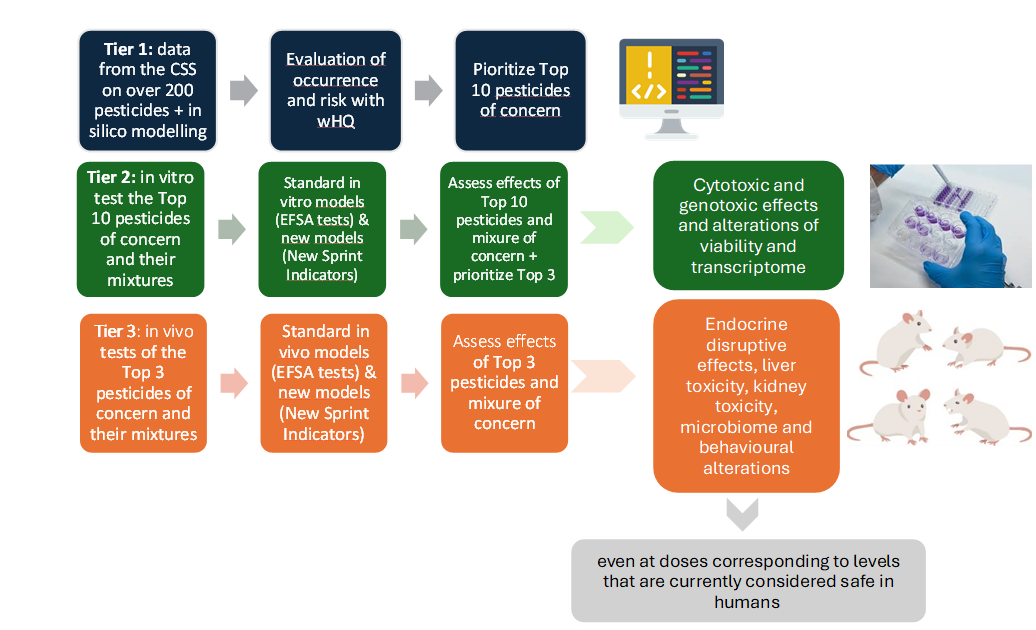
The in vitro (Tier 2) and in vivo (Tier 3) tests used two types of methods:
- EFSA Tests, which are standard lab tests already used to assess risks to humans
- The New SPRINT Indicators, which are new testing models that could be useful in the future, but are not yet officially included in current guidelines.
|
Test organism |
Indicators (references) |
Duration (Days) |
|
EFSA test |
||
|
In vitro: Human cell lines |
Cytotoxicity, micronuclei test (ISO 10993-3: OECD TG 487). |
3 |
|
In vivo: Rats (Sprague-Dawley) |
Reproductive/developmental toxicity, target organ toxicity, hematological and hormonal changes, microbiome (13-week study NTP, NTP 2011). |
90 |
|
New SPRINT Indicator |
||
|
In vitro: human organoids/cell lines of kidney, colon, ileum and airway |
Transcriptomic and differential gene expression analyses, growth viability and cell lineage differentiation. |
3, 90 |
|
In vivo: mouse behavioural assay |
Behavioural tests in animal models of mood disorder; subsequent changes in immune, endocrine and physiological systems. |
56 |
|
In vivo: faecal matter transplant mouse assay |
Behavioural (as above) in mice animal receiving faecal transplant from pesticide-treated donors. |
|
References:
- EFSA, 2019: More, S.J., Bampidis, V., Benford, D., Bennekou, S.H., Bragard, C., Halldorsson, T.I., Hernández‐Jerez, A.F., Koutsoumanis, K., Naegeli, H., Schlatter, J.R., Silano, V., Nielsen, S.S., Schrenk, D., Turck, D., Younes, M., Benfenati, E., Castle, L., Cedergreen, N., Hardy, A., Laskowski, R., Leblanc, J.C., Kortenkamp, A., Ragas, A., Posthuma, L., Svendsen, C., Solecki, R., Testai, E., Dujardin, B., Kass, G.E., Manini, P., Jeddi, M.Z., Dorne, J.C., Hogstrand, C., 2019. Guidance on harmonised methodologies for human health, animal health and ecological risk assessment of combined exposure to multiple chemicals. EFSA Journal 17. https://doi.org/10.2903/j.efsa.2019.5634.