
Authors: Paula S. Tourinho, MU (paula.tourinho@recetox.muni.cz) and Nelson Abrantes, UA (njabrantes@ua.pt)
Last update: 05/02/2026
A significant goal of the SPRINT project was to conduct ecotoxicity testing of pesticide mixtures on aquatic and terrestrial non-target species. The focus of that effort is not only on standardized single-species low-tier assays with EFSA test organisms but also on native species, new endpoints, and higher-tier testing systems, named hereby SPRINT indicators.
The testing concept chosen for the SPRINT project was based on a whole-mixture approach – i.e., organisms are exposed to the pesticide mixtures and the effects are evaluated (in contrast to the calculation approach based on single substances testing).
Selection of the pesticide mixtures was based on a prioritization process using the pesticide residue data based on the SPRINT survey 2021 performed at case study sites (CSS), substance properties, and hazard data. In this process, a risk quotient was calculated as the ratio of exposure to hazard data, specific to each test species. For each pesticide, the risk quotient was then multiplied by its frequency of occurrence in soil and water samples.
The prioritization approach is illustrated below. Further methodological details can be found in Jegede et al. (2025) and in Abrantes et al. (2024).
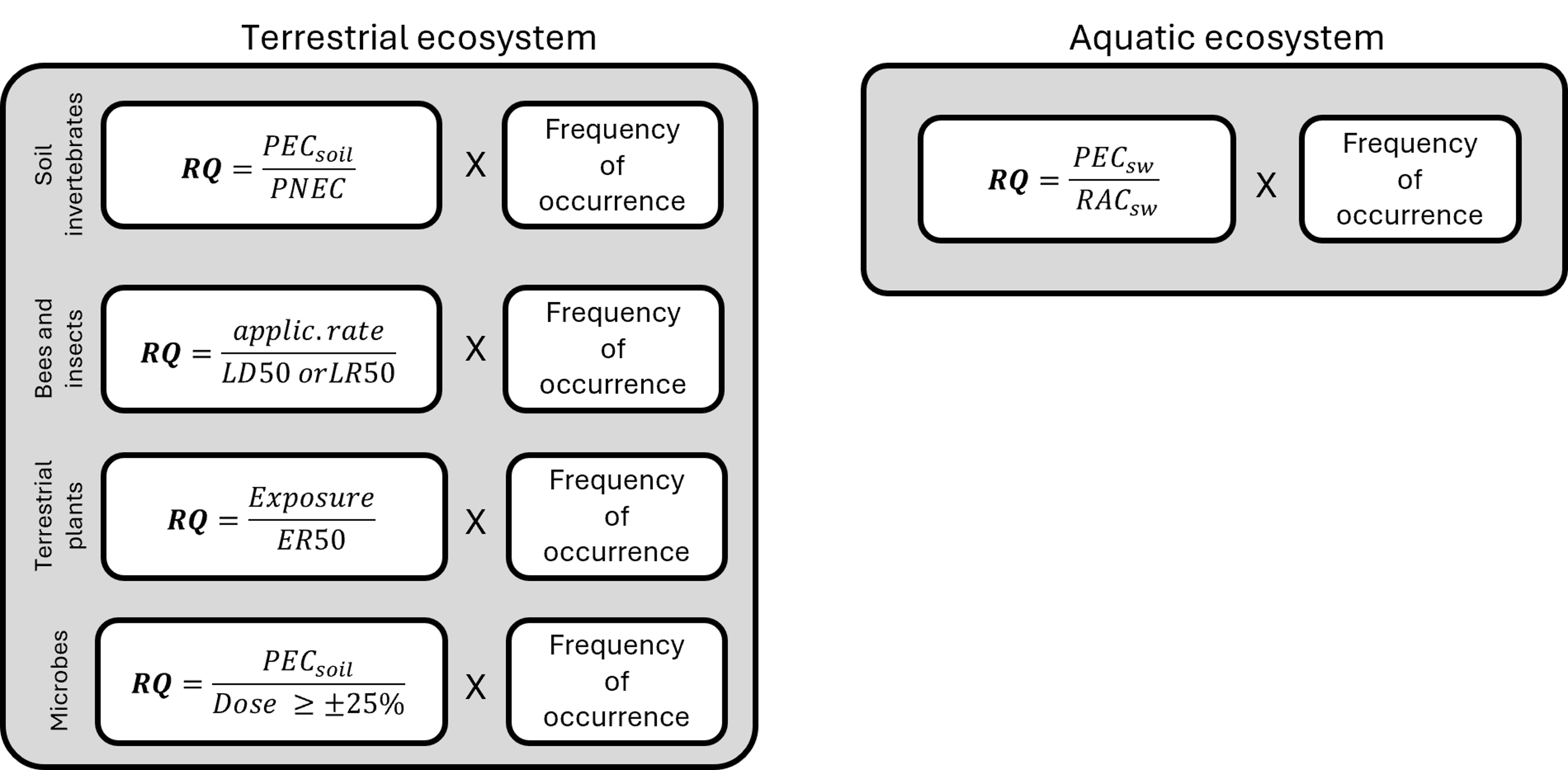
Glossary: RQ: risk quotient; PECsoil: predicted environmental concentration in soil; PNEC: predicted no-effect concentration; applic. rate: application rate; LD50: median lethal dose; LR50: median lethal rate; ER50: median effective rate; PECsw: predicted environmental concentration in surface water; RACsw: Regulatory acceptable concentrations in surface water.
References:
- Jegede, O., Tourinho, P.S., Geissen, V., Hofman, J., 2025. Prioritization of currently used pesticides in soils of main European cropping systems and an Argentinian cropping system for assessment of mixture toxicity and risk on terrestrial biota. Journal of Hazardous Materials 495, 138942. https://doi.org/10.1016/j.jhazmat.2025.138942
- Abrantes, N., Pereira, J.L., González, A.-B.M., Campos, I., Navarro, I., De La Torre, A., Martínez, M.Á., Osman, R., Khurshid, C., Harkes, P., Lwanga, E.H., Alcon, F., Contreras, J., Baldi, I., Bureau, M., Alaoui, A., Christ, F., Mandrioli, D., Sgargi, D., Pasković, I., Pasković, M.P., Glavan, M., Hofman, J., Norgaard, T., Aparicio, V., Silva, V., 2024. Towards a comprehensive methodology for ecotoxicological assessment: Prioritizing plant protection products for mixture testing in edge-of-field surface waterbodies. Science of The Total Environment 956, 177322.https://doi.org/10.1016/j.scitotenv.2024.177322